
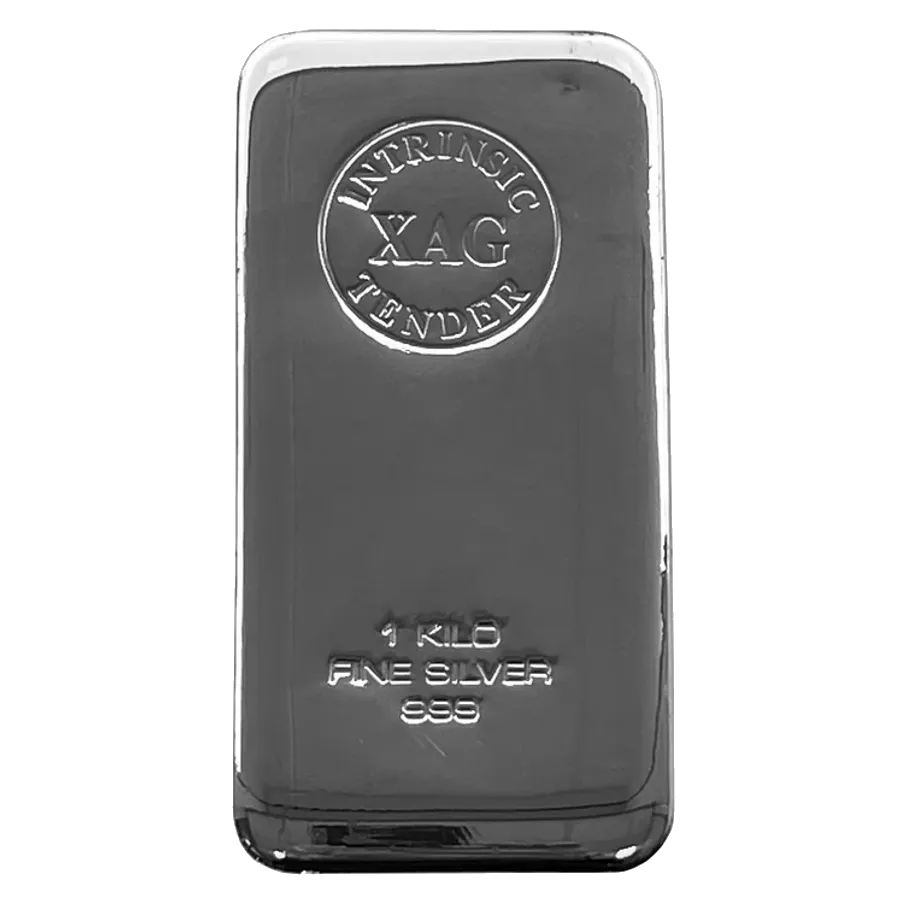
Bars, coins and rounds all deliver the same thing, which is physical metal you own outright. Where they differ is cost per ounce, how easily you can sell them, and how finely you can break up a holding. Understanding those three trade offs is most of what a new buyer needs.
The three formats
Coins are struck by government mints and carry a face value as legal tender. The Canadian Maple Leaf, the Austrian Philharmonic and the Britannia are all sovereign coins. The face value is nominal and has nothing to do with the metal content, but the sovereign backing means the weight and purity are guaranteed by a national mint.
Rounds look like coins but are produced by private mints and are not legal tender. They carry no face value and no sovereign guarantee, which usually makes them cheaper per ounce than a comparable coin.
Bars come in two production styles. Cast bars are made by pouring molten metal into a mould, which gives them a rougher, more organic finish. Minted bars are cut from rolled sheet and struck, giving sharp edges and a polished face. Cast bars are cheaper to produce, minted bars look better and often come sealed in an assay card.
Cost per ounce
This is where the formats separate most clearly. Every bullion product costs more than the raw metal, and the gap covers fabrication, distribution and the dealer's margin.
As a general rule, bars carry the lowest cost above spot, rounds sit in the middle, and sovereign coins carry the most. Bars tend to have lower premiums than coins because minting bars costs less, and larger bars are cheaper per ounce than smaller ones because fixed refining costs are spread across more metal.
The practical consequence is that if your single goal is maximum weight for your money, larger bars win. The trade off is that a one kilogram bar is a single indivisible unit.
Selling it again
Buying is the easy half. How readily a product converts back to cash matters just as much.
Sovereign coins are the most widely recognised bullion products in the world. A Maple Leaf or a Silver Eagle is identifiable on sight by any dealer in any country, which makes it straightforward to sell and generally supports a tighter spread between buying and selling prices.
Bars from well known refiners are also easy to move. Bars from obscure or unfamiliar mints can attract more scrutiny at resale, and some dealers will want to verify them before quoting. Sticking to recognised names avoids that friction.
Divisibility
A holding made up of one ounce coins can be sold one ounce at a time. A holding made up of kilogram bars cannot. If you think you may want to sell in portions rather than all at once, smaller units give you that flexibility, and the slightly higher cost per ounce is what you pay for it.
This is the single most common regret we hear from buyers who bought large and later wanted to release part of a holding.
A practical way to decide
Three questions usually settle it.
What is your priority, weight or flexibility? If it is raw weight, go larger and go to bars. If it is flexibility, go smaller and lean toward coins and rounds.
Where will you sell it? If you may sell overseas or through an unfamiliar dealer, sovereign coins travel best.
Are you buying gold or silver? Silver's lower value per ounce means fixed costs like minting and shipping make up a larger share of the price, so the percentage cost above spot is higher across every silver format. Buying silver in larger units narrows that gap noticeably.
Most buyers who hold for a long time end up with a mix. Coins for recognition and divisibility, bars for efficient weight. There is no rule that says you have to pick one.
Frequently asked questions
Are gold bars cheaper than gold coins?
Per ounce of metal, usually yes. Bars cost less to manufacture than struck sovereign coins, and that difference shows up in the price above spot.
What is the difference between a coin and a round?
A coin is issued by a government mint and is legal tender with a face value. A round is privately minted, has no face value, and is not legal tender. Both can be the same weight and purity.
Are cast bars or minted bars better?
Neither is better as metal. Cast bars are cheaper and have a rougher finish. Minted bars have a polished struck finish and often come in sealed assay packaging, which some buyers prefer for presentation and verification.
Which format is easiest to sell?
Widely recognised sovereign coins, followed by bars from well known refiners.
Browse the range
We stock coins, rounds and bars across gold, silver, platinum, copper and titanium. You can see the full range online or visit the showroom at 124 Peterborough Street, Christchurch.