
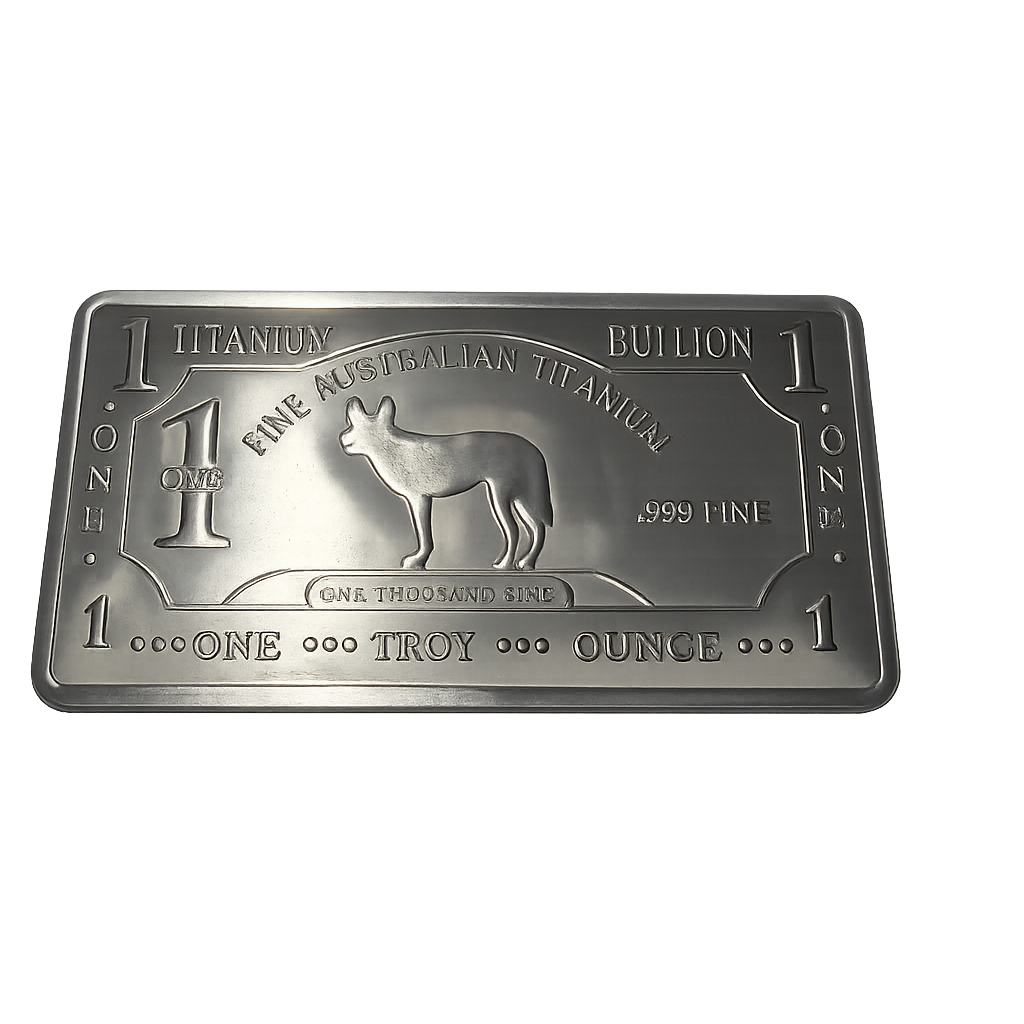
Titanium bullion is uncommon, and most dealers do not carry it. We do, and it is worth explaining what it is and, just as importantly, what it is not.
What titanium bullion is
Titanium bullion is titanium refined to a stated purity, usually 999 fine, and formed into a bar or round with the weight and purity marked on the face. Like all bullion it is measured in troy ounces, at 31.1035 grams to the ounce.
Physically it is unlike anything else in a bullion cabinet, and the reason is density.
The density surprise
Titanium is remarkably light. Its density is around 4.5 grams per cubic centimetre, against roughly 10.5 for silver and 19.3 for gold. Titanium is a little over four times less dense than gold.
The practical consequence is that a one troy ounce titanium bar is physically much larger than a one troy ounce gold bar, and noticeably larger than a silver one, while weighing exactly the same. People handling titanium bullion for the first time almost always comment on how light it feels for its size. That mismatch between apparent bulk and actual weight is the whole character of the metal.
Why it is difficult to produce
Titanium melts at around 1668 degrees Celsius, far above gold or silver, and it reacts readily with oxygen and nitrogen when molten, so it has to be worked under vacuum or inert gas. It is also hard and tough, which makes striking a clean design considerably more demanding than striking softer precious metals.
This is why titanium bullion is rare, and why the production cost is a large share of the price relative to the raw metal value.
Being straight about what this is
Titanium is not a precious metal and should not be thought of as a substitute for one.
There is no meaningful global dealer network quoting titanium bullion against a spot price the way there is for gold and silver. The resale market is thin. The fabrication cost dominates the price, because titanium as a raw material is inexpensive compared with what it costs to turn it into a finished struck bar.
People buy titanium bullion because it is unusual, because the physical properties are interesting, because it completes a collection across metals, or as a distinctive gift. Those are good reasons. Buying it in the expectation that it behaves like gold is not, and any dealer suggesting otherwise is not being straight with you.
One genuine advantage
Titanium requires effectively no care.
It forms a thin, stable, self repairing oxide layer on contact with air, which is why it is used in marine and medical applications. That layer makes it exceptionally corrosion resistant. Titanium will not tarnish like silver, will not patina like copper, and is not marked by fingerprints in the way softer metals are.
Of everything in a bullion cabinet, titanium is the piece you can leave alone indefinitely and find unchanged.
Frequently asked questions
What purity is titanium bullion?
Typically 999 fine, meaning 999 parts titanium per thousand.
Why is a titanium bar bigger than a gold bar of the same weight?
Titanium is far less dense. At around 4.5 grams per cubic centimetre against gold's 19.3, the same weight occupies over four times the volume.
Does titanium tarnish?
No. Titanium forms a stable protective oxide layer that resists corrosion, so it does not tarnish or patina.
Is titanium a precious metal?
No. It is a technically valuable industrial metal, but it is not classed with gold, silver, platinum or palladium, and it does not trade the same way.
Is titanium magnetic?
Titanium is very weakly paramagnetic and will not stick to a household magnet.
Browse titanium
We stock one troy ounce 999 fine titanium bars, alongside gold, silver, platinum and copper. See the range or visit the showroom at 124 Peterborough Street, Christchurch. If you are looking at unusual metals, our copper bullion guide covers similar ground.